SUMMARY: The chapter on Computer Networks in Class 12 Informatics Practices covers the fundamental concepts and components of computer networking, including types, protocols, and network security. KEY TOPICS: network types, network topologies, transmission media, network devices, TCP/IP model, IP addressing, DNS, network security, firewall, cyber threats
Correct answer: Option 1 —
Both A and R are true, and R is the correct explanation of A.
Q211 Mark
Assertion (A): DNS converts domain names to IP addresses.
Reason (R): Users find domain names easier to remember than numeric IPs.
Show explanationHide explanation
Correct answer: Option 1 —
Both A and R are true, and R is the correct explanation of A.
Statement-Based Questions5 questions
Q221 Mark
Statement 1: A switch is more efficient than a hub.
Statement 2: A switch sends data only to the intended port.
Show answerHide answer
Correct answer: Option 1 —
Both statements are true.
Q231 Mark
Statement 1: HTTP is stateless.
Statement 2: Each request is treated independently.
Show answerHide answer
Correct answer: Option 1 —
Both statements are true.
Q241 Mark
Statement 1: A modem converts digital signals to analog and vice versa.
Statement 2: It allows digital devices to communicate over analog media.
Show answerHide answer
Correct answer: Option 1 —
Both statements are true.
Q251 Mark
Statement 1: Bandwidth is measured in bits per second (bps).
Statement 2: Higher bandwidth means more data transfer per unit time.
Show answerHide answer
Correct answer: Option 1 —
Both statements are true.
Q261 Mark
Statement 1: A firewall controls incoming and outgoing network traffic.
Statement 2: It enforces a security policy.
Show answerHide answer
Correct answer: Option 1 —
Both statements are true.
Case Study / Passage Questions1 question
Q273 Marks
A small office of 15 employees needs a network. The IT consultant suggests a wired star topology with a central switch and a router for Internet. Each desktop has a network card and twisted-pair cable runs to the switch. The switch connects to the router which connects to the ISP modem.
Which topology uses a central device with all nodes connected to it?
ABus
BStar
CRing
DMesh
Which device connects the office LAN to the Internet?
AHub
BSwitch
CRouter
DRepeater
Recommend a network design for the office and justify the choice of devices and topology.
Show answersHide answers
1. Option 2 — Star
2. Option 3 — Router
3. Star topology with a switch is reliable and fast. If one cable fails only that desktop is affected. The router connects the LAN (192.168.x.x) to the Internet performing NAT and firewall functions. Twisted-pair (Cat 6) cables support gigabit speeds. The ISP modem converts the Internet provider's signal to Ethernet that the router understands.
Table-Based Questions4 questions
Q285 Marks
Match each network device with its OSI layer.
Device
OSI layer
Hub
?
Switch
?
Router
?
Bridge
?
Repeater
?
Modem
?
Q296 Marks
Match each network protocol with its port and use.
Protocol
Port
Use
HTTP
?
?
HTTPS
?
?
FTP
?
?
SMTP
?
?
POP3
?
?
DNS
?
?
Q305 Marks
Match each topology with its diagrammatic feature.
Topology
Feature
Bus
?
Star
?
Ring
?
Mesh
?
Tree
?
Q316 Marks
Match each transmission medium with type and use.
Medium
Type
Typical use
Twisted pair
?
?
Coaxial
?
?
Optical fibre
?
?
Microwave
?
?
Satellite
?
?
Bluetooth
?
?
Picture-Based Questions3 questions
Q323 Marks
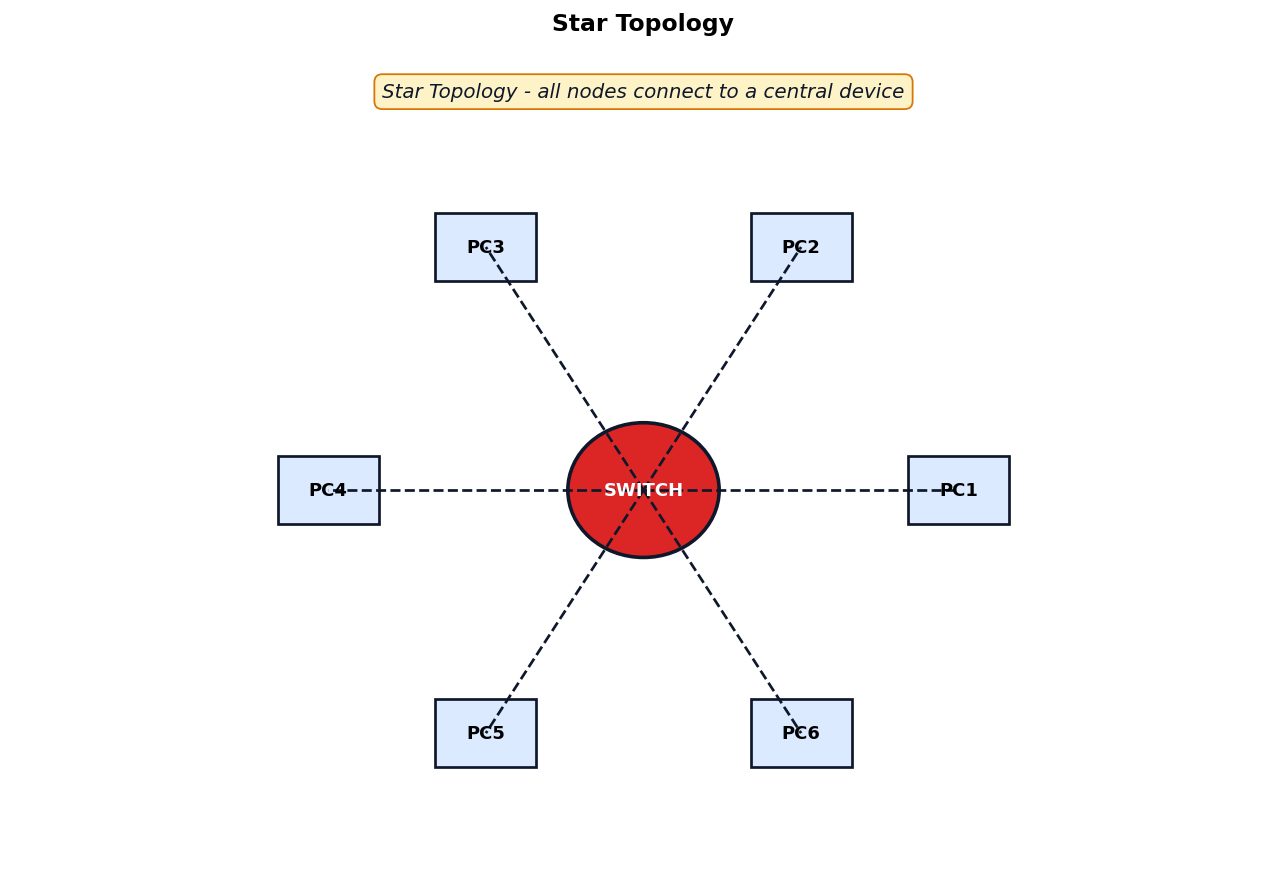
Study the star topology layout and answer:
The topology shown with a central device is:
ABus
BStar
CRing
DMesh
The central device in modern star LANs is typically a:
AHub
BSwitch
CRouter
DRepeater
Discuss star topology with its advantages and disadvantages.
Show answersHide answers
1. Option 2 — Star
2. Option 2 — Switch
3. Star topology connects all nodes to a central device (switch or hub). Advantages: easy to install reliable (a single cable failure affects only one device) high throughput. Disadvantage: central device failure brings down the whole network. Most modern LANs use star topology with a switch.
Q333 Marks
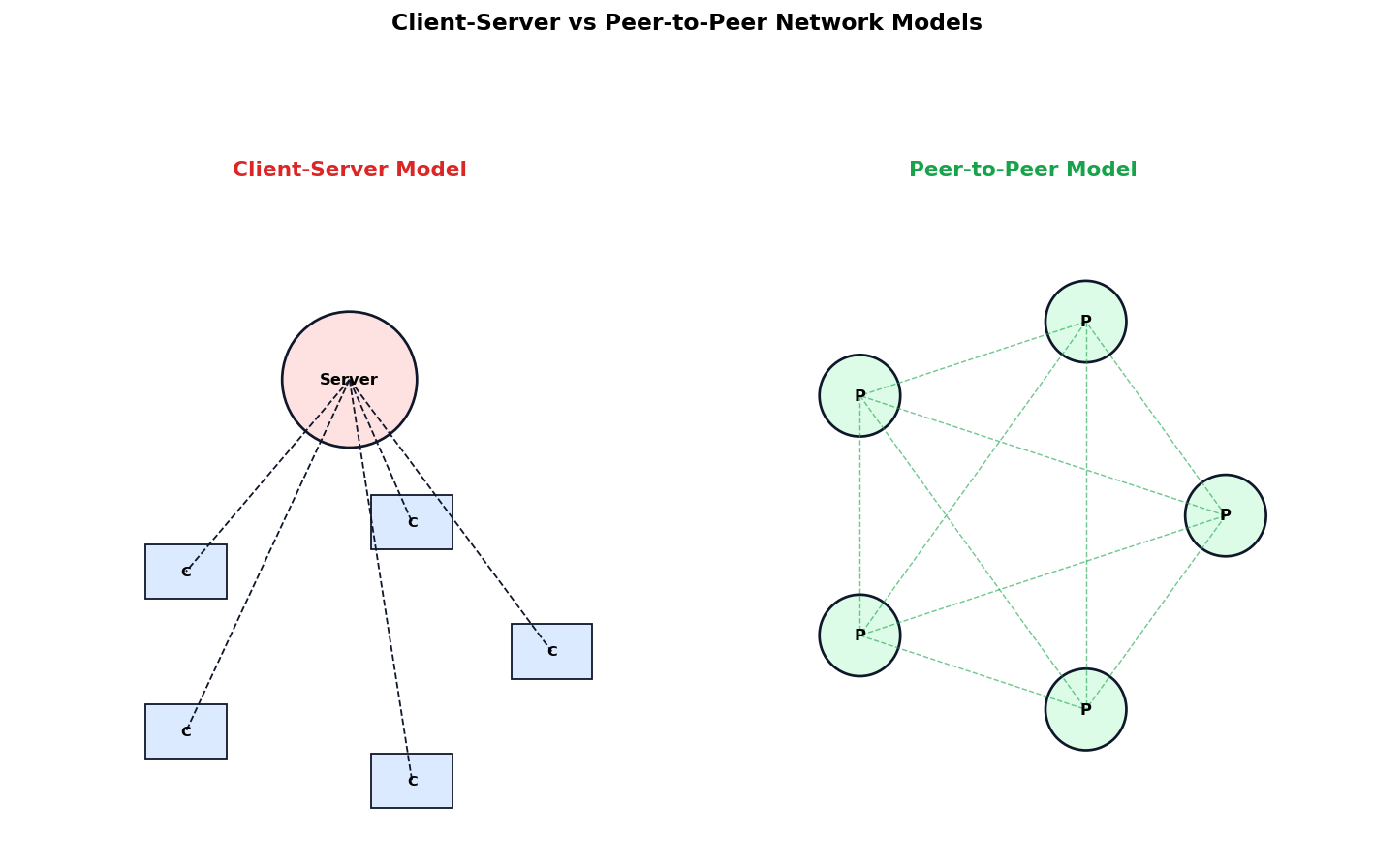
Study the client-server vs peer-to-peer diagram and answer:
In which model do all nodes act as both client and server?
AClient-server
BPeer-to-peer
CBoth
DNeither
In which model is there a central authority providing services?
AClient-server
BPeer-to-peer
CBoth
DNeither
Compare client-server and peer-to-peer network models with examples.
Show answersHide answers
1. Option 2 — Peer-to-peer
2. Option 1 — Client-server
3. In the client-server model a central server provides services and clients request them. Used for web hosting email databases. Reliable but the server is a bottleneck. In peer-to-peer (P2P) every node acts as both client and server sharing resources directly. Used for file sharing (BitTorrent) and cryptocurrencies. Decentralised but harder to control.
Q343 Marks
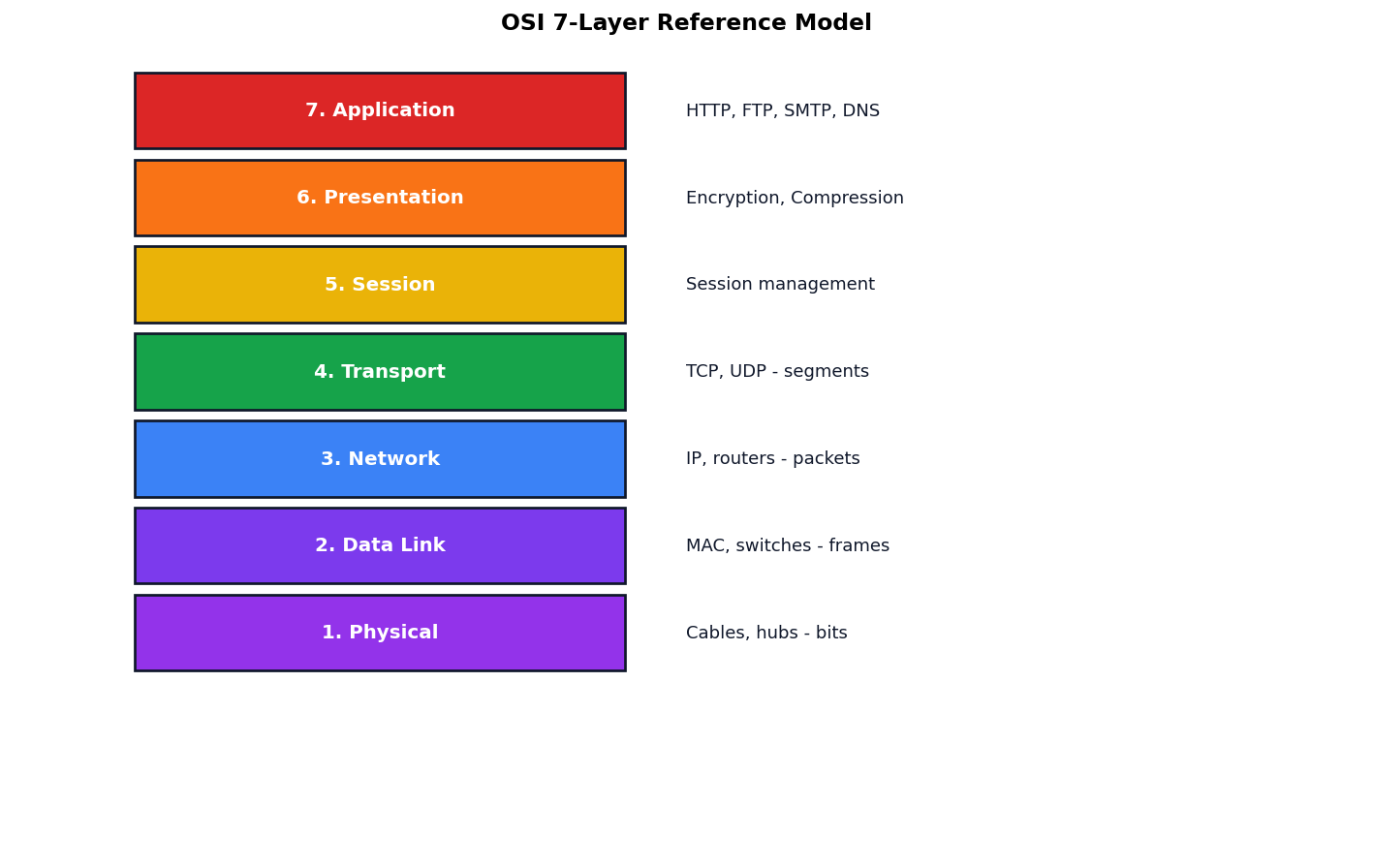
Study the OSI 7-layer model and answer:
Routers operate at which OSI layer?
APhysical
BData Link
CNetwork
DTransport
HTTP and FTP belong to which OSI layer?
ATransport
BApplication
CNetwork
DSession
Discuss the seven layers of the OSI model with their function.
Show answersHide answers
1. Option 3 — Network
2. Option 2 — Application
3. The OSI model has 7 layers from bottom to top: Physical (cables hubs - bits) Data Link (MAC switches - frames) Network (IP routers - packets) Transport (TCP UDP - segments) Session Presentation Application (HTTP FTP). Each layer adds its own header and only communicates with adjacent layers.