Skip to content
TestMacher
Chapter 5 · Class 11 Informatics Practices

Introduction to the Internet — Important Questions

32 questions With answers CBSE format

SUMMARY: This chapter introduces students to the fundamental concepts and workings of the Internet, including its history, architecture, and services.
KEY TOPICS: Internet history, Internet architecture, IP addresses, domain names, web browsers, search engines, email, World Wide Web, Internet protocols, cybersecurity basics

Q1 1 Mark

The Internet is a network of:

ANetworks
BComputers
CServers only
DRouters only
Check answerHide answer
Correct answer: Option 1 — Networks
Q2 1 Mark

Which of the following is a unique address of a website?

ADomain name
BURL
CIP address
DAll of these
Check answerHide answer
Correct answer: Option 4 — All of these
Q3 1 Mark

Which protocol is used to transfer web pages?

AFTP
BHTTP
CSMTP
DPOP3
Check answerHide answer
Correct answer: Option 2 — HTTP
Q4 1 Mark

Which of the following is a web browser?

AGoogle Chrome
BOutlook
CExcel
DVLC
Check answerHide answer
Correct answer: Option 1 — Google Chrome
Q5 1 Mark

Which of the following is NOT an internet service?

AEmail
BFTP
CWWW
DRAM
Check answerHide answer
Correct answer: Option 4 — RAM
Q6 3 Marks

Differentiate between Internet and World Wide Web (WWW).

Q7 3 Marks

Define URL and give one example.

Q8 3 Marks

What is a search engine? Give two examples.

Q9 3 Marks

Differentiate between static and dynamic web pages.

Q10 3 Marks

Define email and explain SMTP and POP3.

Q11 6 Marks

Discuss any five common Internet services with their use.

Q12 6 Marks

Explain the working of a web browser when a user requests a webpage.

Q13 6 Marks

Discuss commonly used Internet protocols (HTTP HTTPS FTP SMTP POP3 IMAP) with their function.

Q14 6 Marks

Explain the role of DNS in resolving domain names to IP addresses.

Q15 6 Marks

Discuss the difference between Internet and Intranet with examples.

Q16 6 Marks

Differentiate between Internet and Intranet in tabular form on five features.

Q17 1 Mark

Assertion (A): The Internet is a global network.

Reason (R): It connects millions of private public academic and government networks.

Show explanationHide explanation
Correct answer: Option 1 — Both A and R are true, and R is the correct explanation of A.
Q18 1 Mark

Assertion (A): DNS converts domain names to IP addresses.

Reason (R): Users find domain names easier to remember than numeric IPs.

Show explanationHide explanation
Correct answer: Option 1 — Both A and R are true, and R is the correct explanation of A.
Q19 1 Mark

Assertion (A): A web browser is a software for accessing websites.

Reason (R): Examples include Chrome Firefox and Edge.

Show explanationHide explanation
Correct answer: Option 1 — Both A and R are true, and R is the correct explanation of A.
Q20 1 Mark

Assertion (A): HTTPS is more secure than HTTP.

Reason (R): HTTPS uses SSL/TLS to encrypt the data in transit.

Show explanationHide explanation
Correct answer: Option 1 — Both A and R are true, and R is the correct explanation of A.
Q21 1 Mark

Assertion (A): FTP is used to transfer files over the Internet.

Reason (R): It supports both upload and download.

Show explanationHide explanation
Correct answer: Option 1 — Both A and R are true, and R is the correct explanation of A.
Q22 1 Mark

Statement 1: The Internet is a network of networks.

Statement 2: WWW is a service running on the Internet.

Show answerHide answer
Correct answer: Option 1 — Both statements are true.
Q23 1 Mark

Statement 1: An IP address uniquely identifies a device on the Internet.

Statement 2: IPv4 uses 32 bits and IPv6 uses 128 bits.

Show answerHide answer
Correct answer: Option 1 — Both statements are true.
Q24 1 Mark

Statement 1: A URL specifies the location of a resource.

Statement 2: It includes protocol domain name and path.

Show answerHide answer
Correct answer: Option 1 — Both statements are true.
Q25 1 Mark

Statement 1: Cookies store small pieces of data on the user's computer.

Statement 2: They help websites remember user preferences and login state.

Show answerHide answer
Correct answer: Option 1 — Both statements are true.
Q26 1 Mark

Statement 1: Search engines crawl the web and index web pages.

Statement 2: Examples include Google Bing and DuckDuckGo.

Show answerHide answer
Correct answer: Option 1 — Both statements are true.
Q27 6 Marks

Match each Internet protocol with its purpose.

ProtocolPurposePort
HTTP??
HTTPS??
FTP??
SMTP??
POP3??
IMAP??
Q28 5 Marks

Match each web term with its meaning.

TermMeaning
URL?
DNS?
HTML?
CSS?
WWW?
Q29 5 Marks

Match each web concept with its description.

ConceptDescription
Website?
Web browser?
Web server?
Search engine?
Cookie?
ISP?
Q30 3 Marks

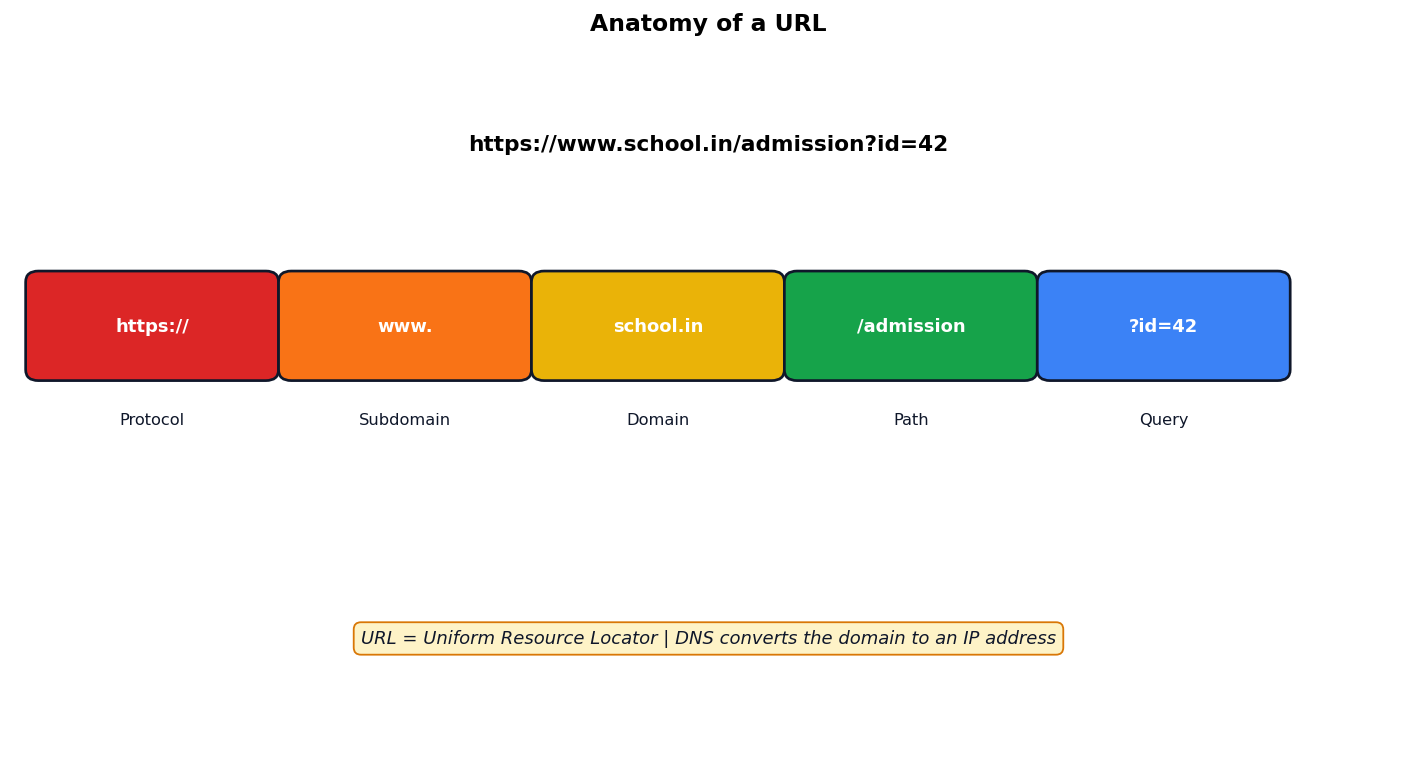
Study the URL anatomy diagram and answer:

Introduction to the Internet figure
  1. In the URL https://www.school.in/admission?id=42 what is 'https://'?
    AProtocol
    BDomain
    CPath
    DQuery
  2. DNS converts what into an IP address?
    ADomain name
    BIP address
    CSubnet
    DPort
  3. Explain the parts of a URL and the role of DNS.
Show answersHide answers
1. Option 1 — Protocol
2. Option 1 — Domain name
3. A URL has parts: protocol (https://) subdomain (www.) domain name (school.in) path (/admission) and optional query string (?id=42). DNS converts the domain name to an IP address so the browser can connect to the right server. HTTPS uses SSL/TLS to encrypt traffic.
Q31 3 Marks

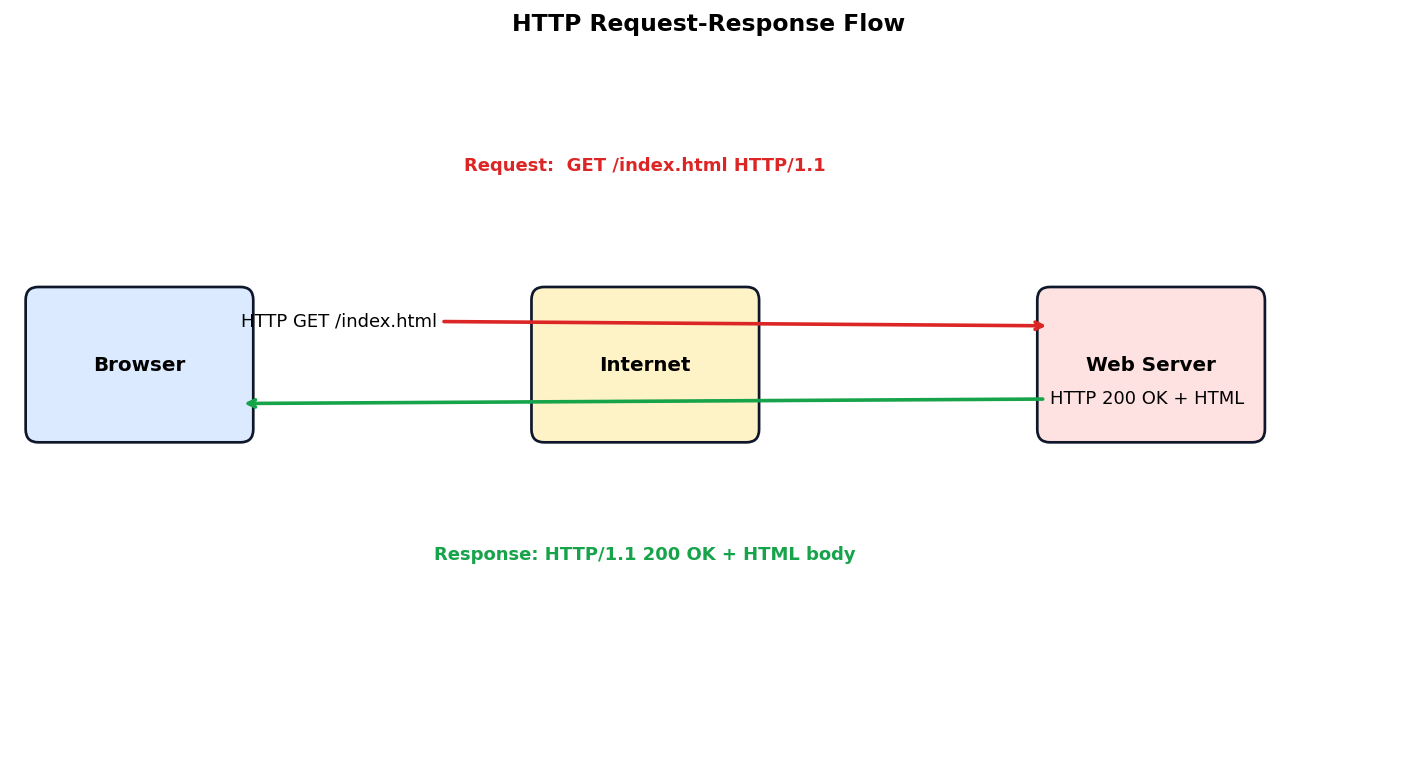
Study the HTTP request-response flow and answer:

Introduction to the Internet figure
  1. Which HTTP method requests a resource?
    AGET
    BPOST
    CPUT
    DDELETE
  2. The success status code is:
    A200 OK
    B404 Not Found
    C500 Internal
    D301 Moved
  3. Discuss the HTTP request-response cycle and common status codes.
Show answersHide answers
1. Option 1 — GET
2. Option 1 — 200 OK
3. HTTP follows a request-response model. The browser sends a request (e.g., GET /index.html) over the Internet to the web server. The server processes it and sends back a response with a status code (200 OK 404 Not Found 500 Internal Error etc.) and the requested content. HTTPS is the secure variant using SSL/TLS.
Q32 3 Marks

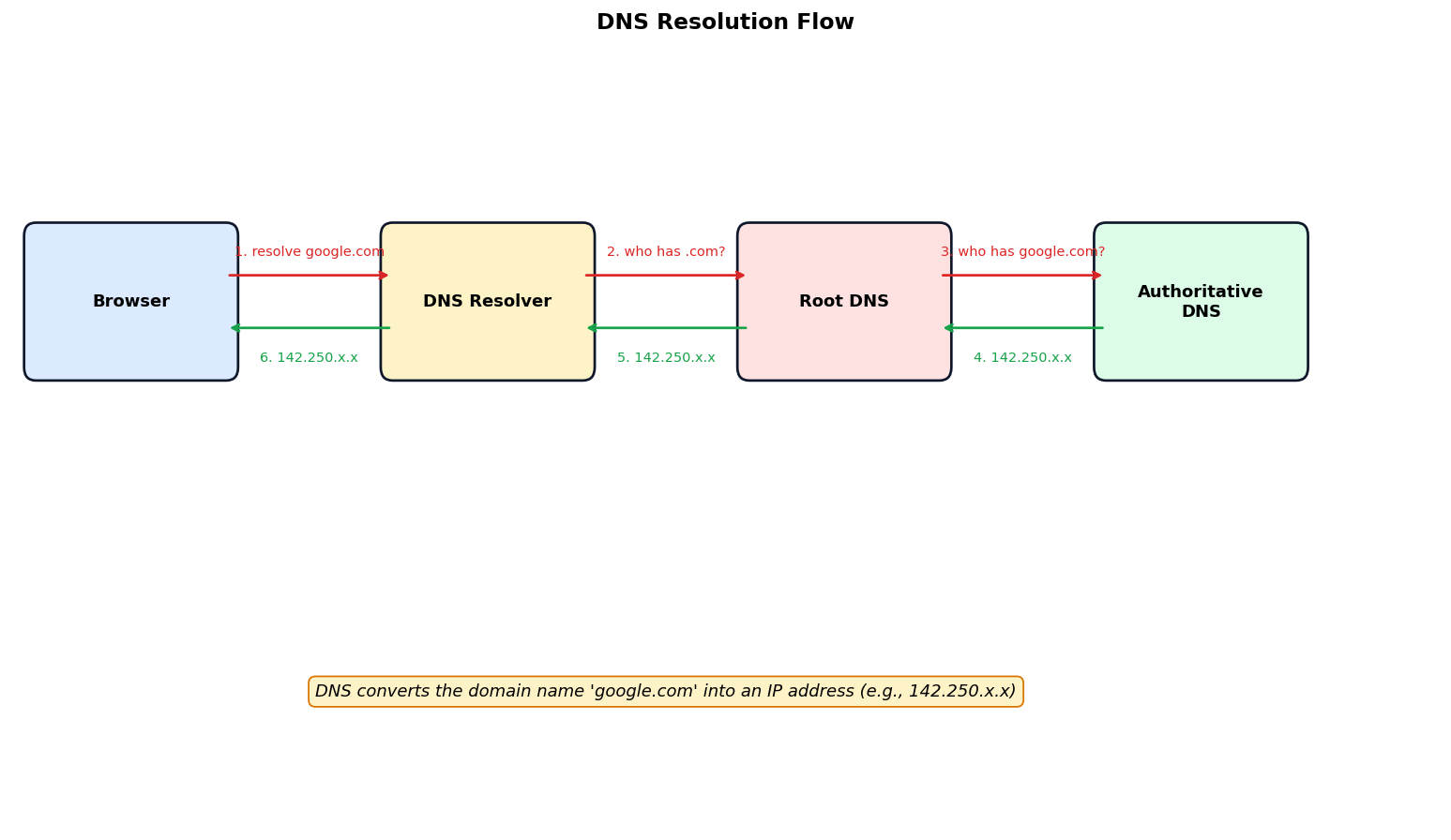
Study the DNS resolution flow and answer:

Introduction to the Internet figure
  1. What does DNS primarily do?
    ADomain to IP
    BIP to domain
    CMAC to IP
    DIP to MAC
  2. Which entity does the DNS lookup on behalf of the browser?
    ADNS Resolver
    BBrowser
    CWeb Server
    DISP
  3. Explain how DNS resolves a domain name into an IP address.
Show answersHide answers
1. Option 1 — Domain to IP
2. Option 1 — DNS Resolver
3. DNS (Domain Name System) translates human-readable domain names to numerical IP addresses. When you type google.com the browser asks the DNS resolver. The resolver queries root DNS then top-level domain DNS then the authoritative DNS to get the IP. The IP is returned and cached for future lookups.

Make a full Informatics Practices paper on Introduction to the Internet.

Pick the question mix, set the marks, hit generate. You get a ready-to-print paper with an answer key.

Generate your paper — free