SUMMARY: This chapter introduces students to the basics of Python programming, including its syntax and fundamental concepts. KEY TOPICS: Python syntax, variables, data types, operators, input/output functions, conditional statements, loops, functions, error handling, Python IDEs
Which of the following is a valid Python identifier?
A2name
Bname_2
Cname 2
Dfor
Check answerHide answer
Correct answer: Option 2 — name_2
Q21 Mark
Which keyword is used to define a function in Python?
Afunction
Bdef
Cfun
Ddefine
Check answerHide answer
Correct answer: Option 2 — def
Q31 Mark
The output of print(7 // 2) in Python is:
A3.5
B3
C4
D3.0
Check answerHide answer
Correct answer: Option 2 — 3
Q41 Mark
Lists in Python are:
AMutable
BImmutable
CConstants
DHashable only
Check answerHide answer
Correct answer: Option 1 — Mutable
Q51 Mark
Tuples in Python are:
AMutable
BImmutable
CHashable
DBoth immutable and hashable
Check answerHide answer
Correct answer: Option 4 — Both immutable and hashable
Short Answer Questions5 questions
Q63 Marks
Differentiate between mutable and immutable data types in Python.
Q73 Marks
List any three rules for naming a variable in Python.
Q83 Marks
Differentiate between list and tuple in Python.
Q93 Marks
What is the difference between print() and input()?
Q103 Marks
How are dictionaries different from lists in Python?
Long Answer Questions6 questions
Q116 Marks
Write a Python program to find the largest of three numbers using if-elif-else.
Q126 Marks
Write a Python program to compute the factorial of a number using a for loop.
Q136 Marks
Discuss different types of operators in Python with examples.
Q146 Marks
Write a Python function that takes a list and returns the sum and average of its elements.
Q156 Marks
Write a Python program to count the number of vowels and consonants in a string.
Q166 Marks
Differentiate between mutable and immutable data types in Python in tabular form.
Assertion–Reason Questions5 questions
Q171 Mark
Assertion (A): Python is dynamically typed.
Reason (R): Variables do not need to be declared with a type.
Show explanationHide explanation
Correct answer: Option 1 —
Both A and R are true, and R is the correct explanation of A.
Q181 Mark
Assertion (A): Indentation is mandatory in Python.
Reason (R): It defines blocks of code.
Show explanationHide explanation
Correct answer: Option 1 —
Both A and R are true, and R is the correct explanation of A.
Q191 Mark
Assertion (A): Strings are immutable in Python.
Reason (R): Once created their characters cannot be changed.
Show explanationHide explanation
Correct answer: Option 1 —
Both A and R are true, and R is the correct explanation of A.
Q201 Mark
Assertion (A): Lists can store elements of different data types.
Reason (R): Python lists are heterogeneous.
Show explanationHide explanation
Correct answer: Option 1 —
Both A and R are true, and R is the correct explanation of A.
Q211 Mark
Assertion (A): Dictionaries are unordered collections.
Reason (R): Items are accessed by key not position.
Show explanationHide explanation
Correct answer: Option 1 —
Both A and R are true, and R is the correct explanation of A.
Statement-Based Questions5 questions
Q221 Mark
Statement 1: A list is created using square brackets.
Statement 2: Lists support indexing and slicing.
Show answerHide answer
Correct answer: Option 1 —
Both statements are true.
Q231 Mark
Statement 1: A tuple is created using parentheses.
Statement 2: Tuples are faster than lists for iteration.
Show answerHide answer
Correct answer: Option 1 —
Both statements are true.
Q241 Mark
Statement 1: A dictionary stores key-value pairs.
Statement 2: Keys must be unique and immutable.
Show answerHide answer
Correct answer: Option 1 —
Both statements are true.
Q251 Mark
Statement 1: Comments in Python begin with #.
Statement 2: They are ignored by the interpreter.
Show answerHide answer
Correct answer: Option 1 —
Both statements are true.
Q261 Mark
Statement 1: The input() function returns a string by default.
Statement 2: Use int() or float() for type conversion.
Show answerHide answer
Correct answer: Option 1 —
Both statements are true.
Case Study / Passage Questions1 question
Q273 Marks
An intern is writing a Python program to compute simple interest using the formula SI = (P * R * T) / 100. He uses input() to read the three values then computes and prints SI. He also wants to print the maturity amount A = P + SI.
To assign a value to a variable in Python use:
A=
B==
C=:
Dis
What does input() return by default?
Aint
Bfloat
Cstr
Dbool
Write the complete Python program with proper type conversion.
Show answersHide answers
1. Option 1 — =
2. Option 3 — str
3. Program: P = float(input('Principal: ')); R = float(input('Rate: ')); T = float(input('Time: ')); SI = (P * R * T) / 100; A = P + SI; print('SI =' SI); print('A =' A). The input() function always returns a string so we use float() to convert. Without conversion the formula would fail or behave unexpectedly.
Table-Based Questions4 questions
Q285 Marks
Identify the data type of each Python literal.
Literal
Type
42
?
3.14
?
'Hello'
?
True
?
[1, 2, 3]
?
(1, 2, 3)
?
Q296 Marks
Predict the output of each Python expression.
Expression
Output
3 + 2 * 4
?
10 / 3
?
10 // 3
?
10 % 3
?
2 ** 3
?
'ab' * 3
?
Q306 Marks
Predict the output of each list operation.
Operation on a = [1, 2, 3]
Result
a.append(4)
?
a.extend([5, 6])
?
a.insert(0, 0)
?
a.remove(3)
?
a.pop()
?
Q316 Marks
Predict the output of each string operation.
s = 'Hello World'
Result
len(s)
?
s.upper()
?
s[0:5]
?
s[-1]
?
s.split()
?
'World' in s
?
Picture-Based Questions3 questions
Q323 Marks
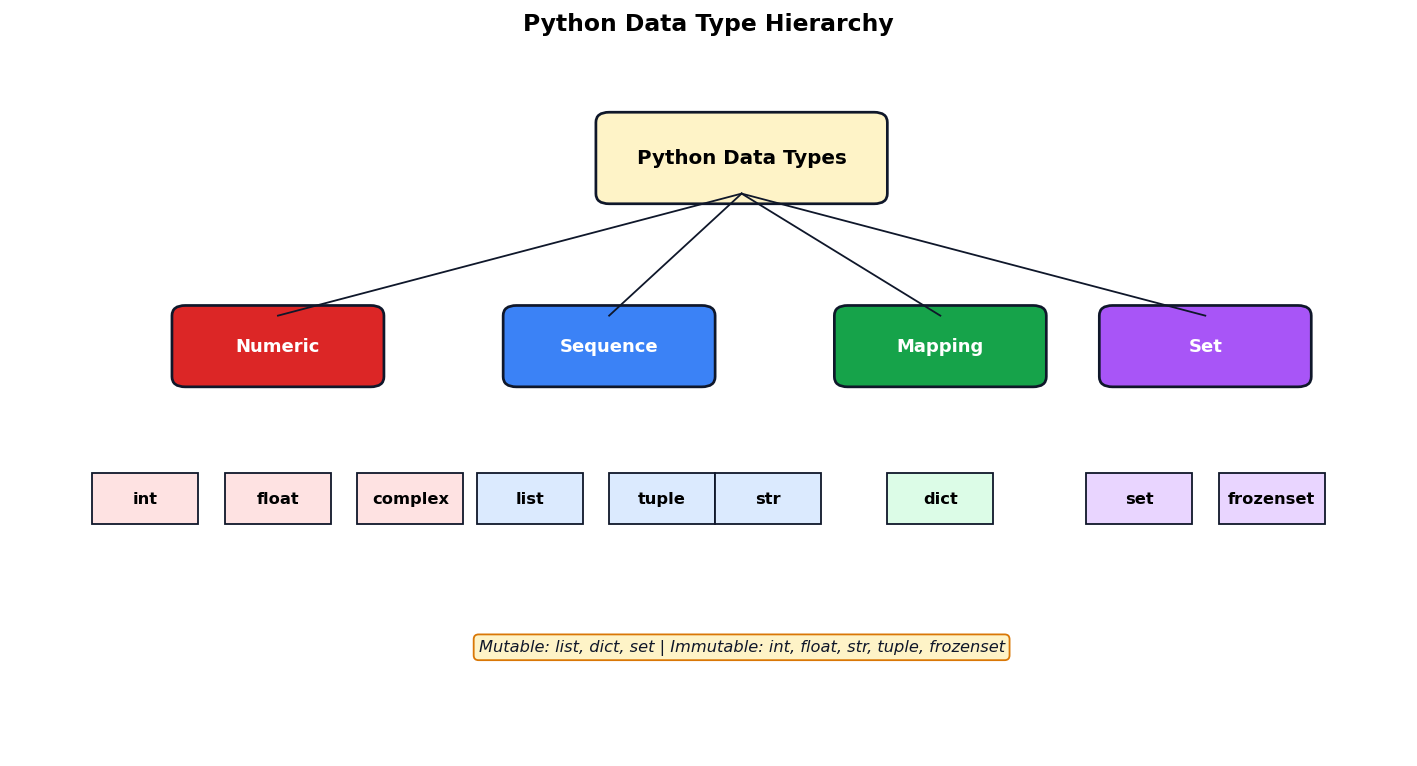
Study the Python data type hierarchy and answer:
Which of the following is a MUTABLE data type?
Aint
Blist
Cstr
Dtuple
Which is an immutable sequence?
Alist
Bdict
Ctuple
Dset
Differentiate between mutable and immutable data types in Python with examples.
Show answersHide answers
1. Option 2 — list
2. Option 3 — tuple
3. Python data types are categorised as Numeric (int float complex) Sequence (list tuple str) Mapping (dict) and Set. Mutable types (list dict set) can be changed in place; immutable types (int float str tuple) cannot.
Q333 Marks
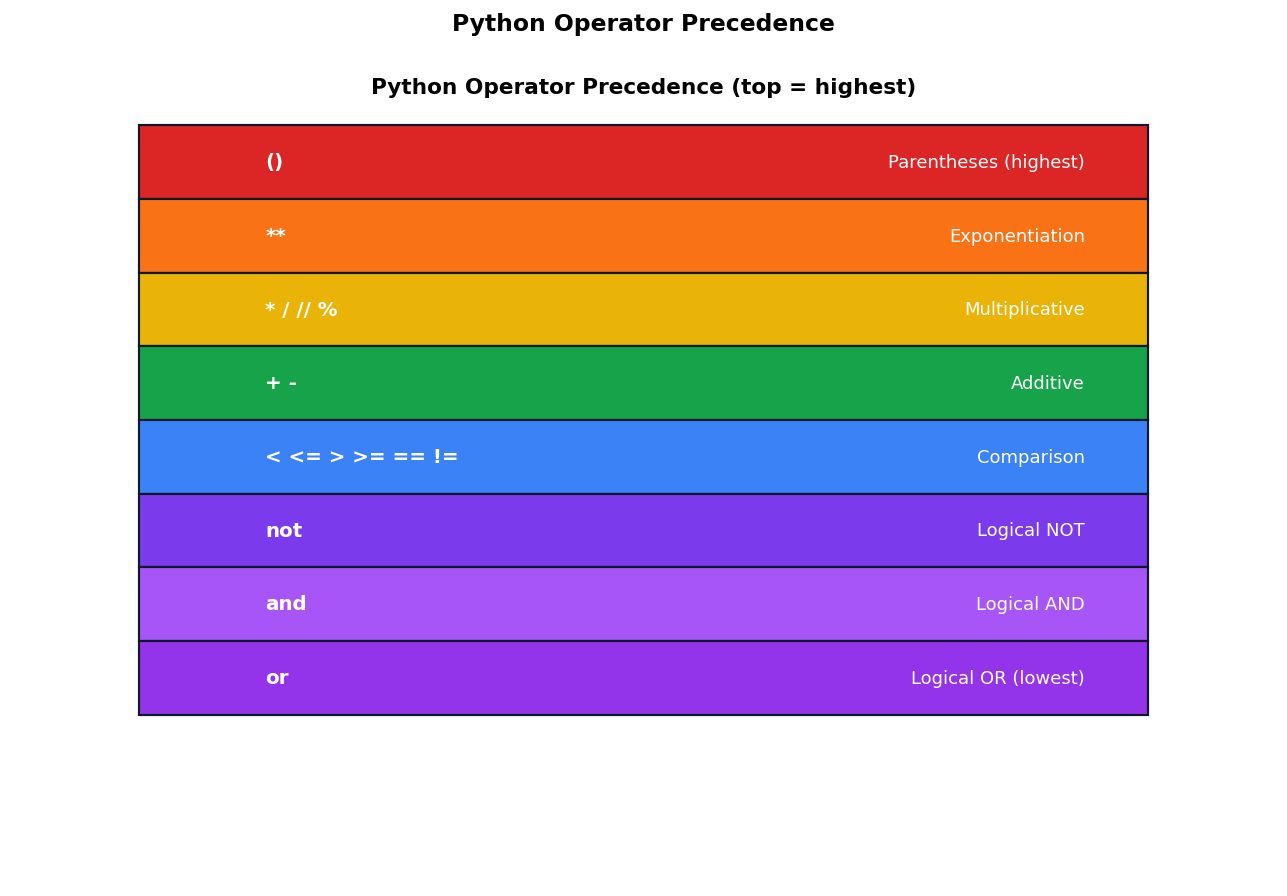
Study the Python operator precedence diagram and answer:
Which has the HIGHEST precedence in Python?
A**
B* / //
C( )
Dnot
Which has the LOWEST precedence?
Aand
Bor
Cnot
D==
Discuss Python operator precedence and how parentheses override it.
Show answersHide answers
1. Option 3 — ( )
2. Option 2 — or
3. Operator precedence determines the order of evaluation in expressions. Parentheses have the highest precedence followed by exponentiation multiplicative operators additive operators comparison logical NOT logical AND and finally logical OR. Use parentheses to override the default precedence.
Q343 Marks
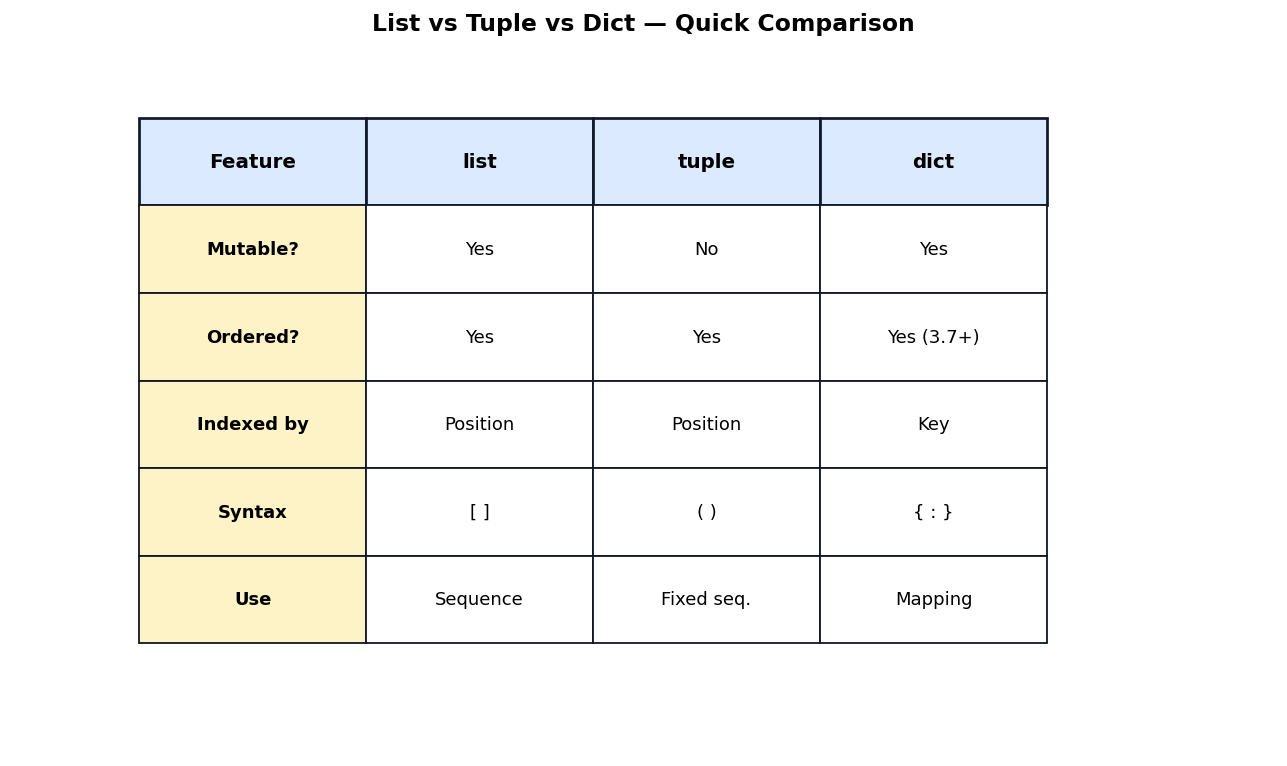
Study the list vs tuple vs dict comparison and answer:
Which is IMMUTABLE?
Alist
Btuple
Cdict
DAll
Which uses curly braces { } and indexes by key?
Alist
Btuple
Cdict
Dset
Compare list tuple and dict on five features.
Show answersHide answers
1. Option 2 — tuple
2. Option 3 — dict
3. Lists are mutable ordered indexed by position use [ ]. Tuples are immutable ordered indexed by position use ( ). Dicts are mutable ordered (3.7+) indexed by key use { : }. Tuples are faster than lists and can serve as dict keys (because they are immutable and hashable).