SUMMARY: This chapter introduces students to the fundamental concepts of databases and their management systems. KEY TOPICS: database, DBMS, relational model, SQL, tables, primary key, foreign key, normalization, ER model, data integrity
Which of the following is a relational database management system?
AExcel
BMS Word
CMySQL
DNotepad
Check answerHide answer
Correct answer: Option 3 — MySQL
Q21 Mark
A primary key in a database table is:
AAlways a single column
BUnique and not null
CAlways a foreign key
DA column with duplicates
Check answerHide answer
Correct answer: Option 2 — Unique and not null
Q31 Mark
Which SQL command is used to retrieve data from a database?
AGET
BSELECT
CFETCH
DRETRIEVE
Check answerHide answer
Correct answer: Option 2 — SELECT
Q41 Mark
Which clause is used to filter rows in SQL?
AWHERE
BFILTER
CHAVING
DIF
Check answerHide answer
Correct answer: Option 1 — WHERE
Q51 Mark
A column in a relational database is called a/an:
ATuple
BAttribute
CRelation
DCardinality
Check answerHide answer
Correct answer: Option 2 — Attribute
Short Answer Questions5 questions
Q63 Marks
Define database and database management system (DBMS).
Q73 Marks
Differentiate between primary key and foreign key.
Q83 Marks
Differentiate between DDL and DML SQL commands with examples.
Q93 Marks
Write a SQL query to display all rows from the table employee.
Q103 Marks
Define cardinality and degree of a relation.
Long Answer Questions6 questions
Q116 Marks
Discuss any five SQL commands (CREATE INSERT SELECT UPDATE DELETE) with one example each.
Q126 Marks
Discuss various database keys (primary candidate alternate foreign composite) with examples.
Q136 Marks
Compare DBMS and traditional file system on five points.
Q146 Marks
Write SQL queries to: (a) create a table student (b) insert 3 rows (c) display students with marks > 80 (d) update marks of one student.
Q156 Marks
Discuss SQL aggregate functions COUNT SUM AVG MAX MIN with examples.
Q166 Marks
Differentiate between primary key and foreign key in tabular form.
Assertion–Reason Questions5 questions
Q171 Mark
Assertion (A): Primary key uniquely identifies each row.
Reason (R): It must be unique and not null.
Show explanationHide explanation
Correct answer: Option 1 —
Both A and R are true, and R is the correct explanation of A.
Q181 Mark
Assertion (A): A foreign key creates a relationship between tables.
Reason (R): It refers to the primary key of another table.
Show explanationHide explanation
Correct answer: Option 1 —
Both A and R are true, and R is the correct explanation of A.
Q191 Mark
Assertion (A): SELECT is a DQL command.
Reason (R): It retrieves data from one or more tables.
Show explanationHide explanation
Correct answer: Option 1 —
Both A and R are true, and R is the correct explanation of A.
Q201 Mark
Assertion (A): DDL commands include CREATE ALTER and DROP.
Reason (R): They define and modify the structure of the database.
Show explanationHide explanation
Correct answer: Option 1 —
Both A and R are true, and R is the correct explanation of A.
Q211 Mark
Assertion (A): A NULL value represents missing data.
Reason (R): It is different from zero or empty string.
Show explanationHide explanation
Correct answer: Option 1 —
Both A and R are true, and R is the correct explanation of A.
Statement-Based Questions5 questions
Q221 Mark
Statement 1: A database is a collection of related data.
Statement 2: A DBMS is software to manage that data.
Show answerHide answer
Correct answer: Option 1 —
Both statements are true.
Q231 Mark
Statement 1: Examples of DBMS include MySQL Oracle and SQL Server.
Statement 2: All support SQL as the standard query language.
Show answerHide answer
Correct answer: Option 1 —
Both statements are true.
Q241 Mark
Statement 1: A row in a relational table is also called a tuple.
Statement 2: A column is also called an attribute.
Show answerHide answer
Correct answer: Option 1 —
Both statements are true.
Q251 Mark
Statement 1: Cardinality of a relation is the number of tuples.
Statement 2: Degree is the number of attributes.
Show answerHide answer
Correct answer: Option 1 —
Both statements are true.
Q261 Mark
Statement 1: SELECT DISTINCT removes duplicates from the result.
Statement 2: It returns unique values for the specified column(s).
Show answerHide answer
Correct answer: Option 1 —
Both statements are true.
Case Study / Passage Questions1 question
Q273 Marks
A school librarian wants a database to manage book records and borrowings. She decides on three tables — Book(book_id title author copies) Member(member_id name class) and BorrowRecord(borrow_id member_id book_id issue_date return_date). She must identify primary and foreign keys.
book_id in the Book table is the:
AComposite key
BPrimary key
CForeign key
DCandidate key
member_id in BorrowRecord referring to Member.member_id is a:
APrimary key
BForeign key
CCandidate key
DComposite key
Identify all primary and foreign keys in the library database design.
Show answersHide answers
1. Option 2 — Primary key
2. Option 2 — Foreign key
3. Book.book_id is the primary key of Book. Member.member_id is the primary key of Member. BorrowRecord.borrow_id is its primary key. BorrowRecord.member_id and BorrowRecord.book_id are foreign keys referring to the primary keys of Member and Book respectively. This relational design avoids data redundancy and enforces referential integrity.
Table-Based Questions4 questions
Q285 Marks
Match each database key with its definition.
Key
Definition
Primary
?
Candidate
?
Alternate
?
Foreign
?
Composite
?
Q296 Marks
For sample employee table compute each SQL aggregate result.
emp_id
name
dept
salary
1
Anil
IT
50000
2
Bobby
HR
40000
3
Chitra
HR
35000
4
Geeta
IT
60000
5
Hari
Sales
40000
Q305 Marks
Match each SQL command type with its commands.
Type
Commands
DDL
?
DML
?
DQL
?
DCL
?
TCL
?
Q313 Marks
Study the database keys table and answer:
Key
Definition
Example
Primary
Unique not null
roll_no
Candidate
Could be primary
roll_no, email
Alternate
Candidate not chosen
email
Foreign
Refers to another
dept_id in Employee
Composite
Multi-column
(order_id, item_id)
Which key uniquely identifies each row and cannot be NULL?
APrimary
BCandidate
CAlternate
DForeign
Which key creates a relationship between two tables?
APrimary
BForeign
CComposite
DAlternate
Explain different types of database keys with one example each.
Show answersHide answers
1. Option 1 — Primary
2. Option 2 — Foreign
3. A primary key uniquely identifies each row. A candidate key can serve as primary (multiple may exist). The alternate key is a candidate not chosen. A foreign key references the primary key of another table — basis of relationships between tables. A composite key uses two or more columns when no single column is unique.
Picture-Based Questions2 questions
Q323 Marks
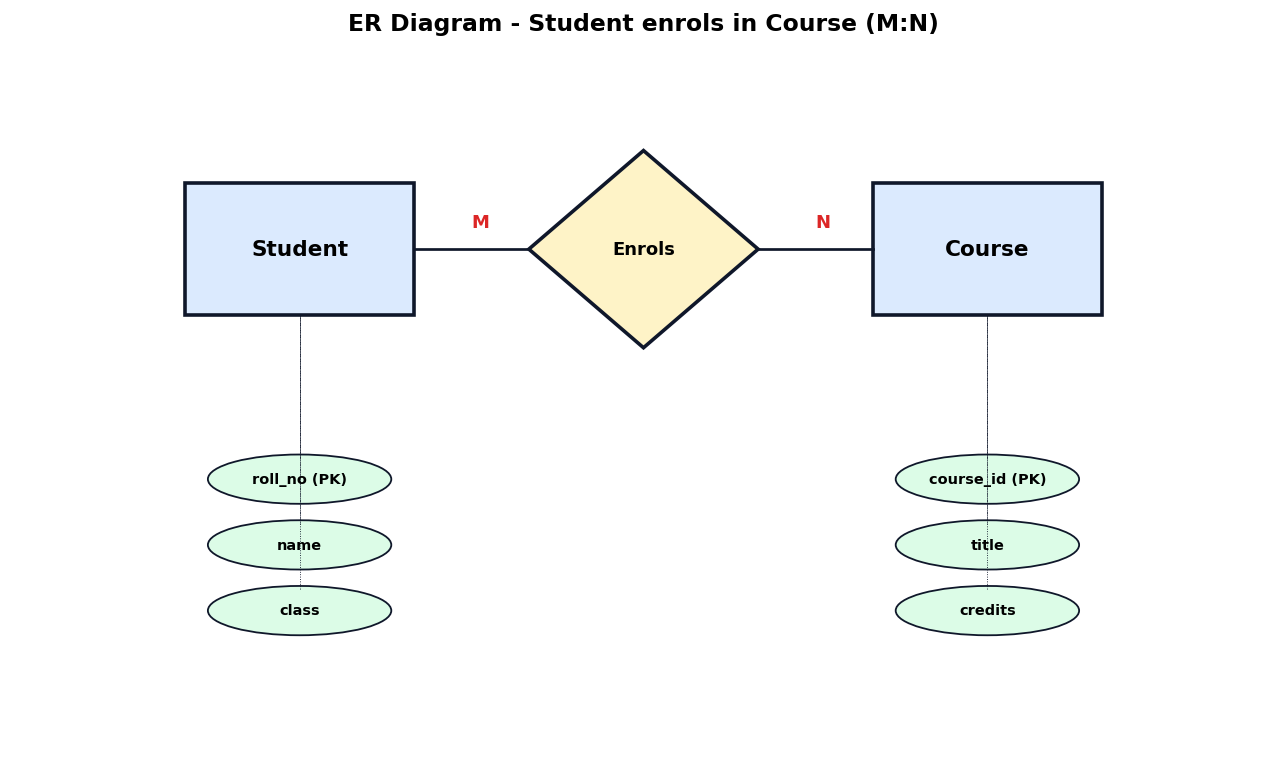
Study the ER diagram of student-course relationship and answer:
Which is a relationship in the ER diagram?
AStudent
BCourse
CEnrols
Droll_no
Entities in an ER diagram are represented by:
ARectangle
BDiamond
CEllipse
DCircle
Explain the components of an ER diagram with the student-course example.
Show answersHide answers
1. Option 3 — Enrols
2. Option 1 — Rectangle
3. In ER diagrams entities are rectangles attributes are ellipses and relationships are diamonds. Cardinality (1:1 1:N M:N) is shown on the relationship lines. Primary keys are underlined. Student-Course is M:N because a student takes many courses and a course has many students.
Q333 Marks
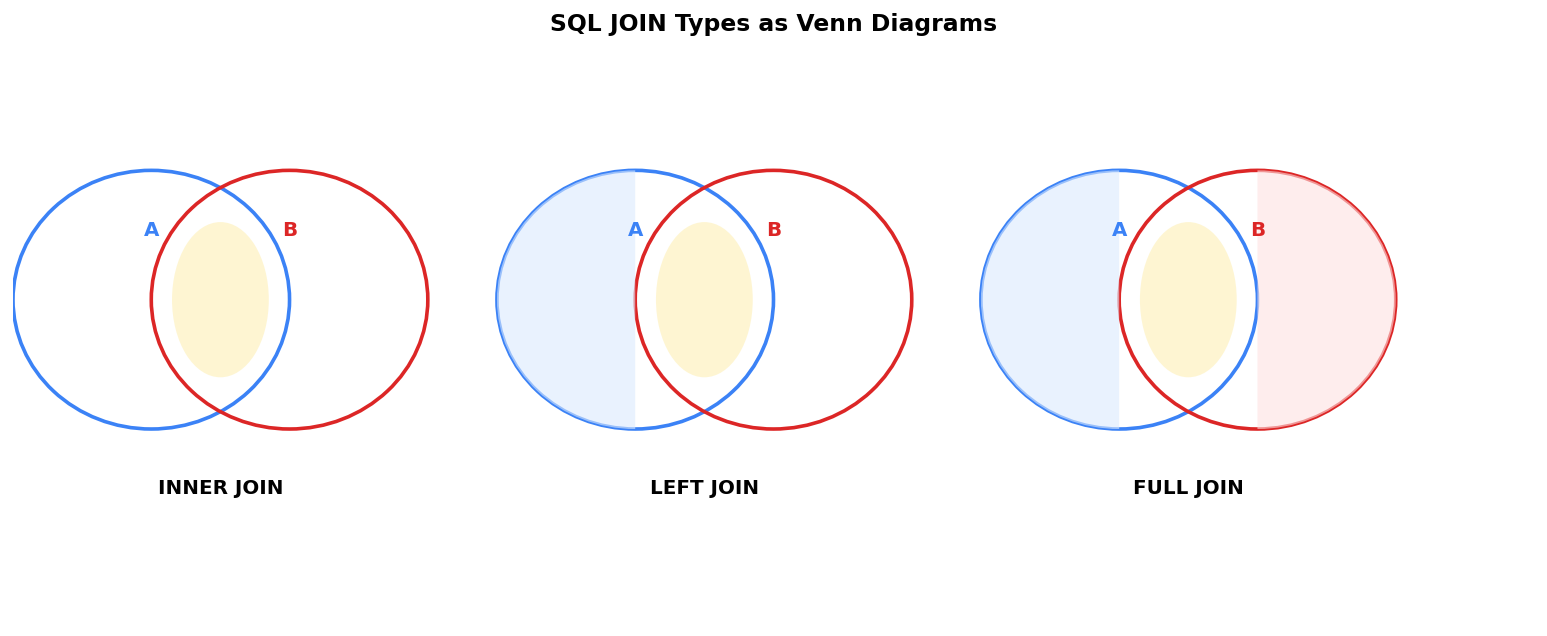
Study the SQL JOIN Venn diagrams and answer:
Which JOIN returns only matching rows from both tables?
AINNER JOIN
BLEFT JOIN
CFULL JOIN
DCROSS JOIN
Which JOIN returns all rows from the LEFT table plus matches from the right?
AINNER
BLEFT
CRIGHT
DFULL
Differentiate between INNER LEFT and FULL JOINs with examples.
Show answersHide answers
1. Option 1 — INNER JOIN
2. Option 2 — LEFT
3. INNER JOIN returns only matching rows. LEFT JOIN returns all rows from left + matching from right (NULL for non-matches). RIGHT JOIN is the mirror. FULL JOIN returns all rows from both. CROSS JOIN returns Cartesian product. JOINs combine rows based on a related column.